
Gen AI has emerged as the go-to solution for overworked marketers, promising faster, cheaper content creation at scale. But in the rush for efficiency, something more vital may be lost – distinction.
With the rapidly expanding and ever-changing social media landscape, the standard marketing process we became so accustomed to has changed. Especially in the last 15 years, not only have brands been required to increase the number of formats in which to create content, they also need to show up in an increasingly diverse variety of locations to thoroughly represent themselves.
Legacy platforms have yet to die off entirely and most of us don’t even want them to. TV ads, cover spreads in magazines, Super Bowl commercials, product sponsorships, etc. will likely continue to be important. These legacies, and the expanding landscape, forces most brands to invest in more work, more training, and more hiring just to keep up.
The easiest way to deal with this was to simply repurpose content by using a couple of hero assets across different platforms but not necessarily investing the time or cost to tailor it for what works best in each space. Some brands have been able to crack this dilemma and create content that’s truly fit for each platform and its community of users. However, that usually requires more planning time and resources to achieve such a strategic approach.
Now with the adoption of Gen AI, the general consensus has been that it will help these businesses create content at a fraction of the cost and at a faster pace than traditional work processes.
The appeal of Generative AI lies in the perception that small teams can now outpace the traditional agency model delivering more, faster, with less. While this could bring great advantages, there is also the risk that using these tools without proper consideration for how it can be integrated into a brand can result in creative homogenization and lower distinctiveness. The fact remains that while AI can outproduce us, it does so only by referencing the existing content on which its model has been trained.
To understand the hype, it’s worth asking what exactly brands believe they are gaining.
Gen AI has enormous potential in offering faster turnaround, higher volume, and the ability to iterate over perfection. For businesses and brands with tighter budgets or limited resources, it can further open the door to Test & Learn experimentation outside of their standard operating procedures. This can be a common sticking point even in the case of larger, more established brands with deeper pockets.
Industry chatter on LinkedIn paints Gen AI as a creative revolution—but how differentiated is the output? Given an open-ended prompt, how creative are these models?
To explore creative variance versus similarity, we analyse 13 generative AI* tools and primed them all with the same prompts and requesting at least one image (ideally two) per tool.
The prompts were designed to simulate two everyday creative requirements a B2C retail brand may face. The first prompt focused on creating a luxury streetwear apparel asset. This prompt assessed how each model interprets the concept of streetwear: their visual language, presentation choices, material use, and integration of stylistic or technological elements. It gave us insight into how creatively (and how distinctively) each model responds to a culturally-nuanced and design-sensitive category.
The second prompt was structured as a fashion retail use case. It included multiple layers: interior design, product display, lighting, and technological elements. The aim was to test each model’s ability to synthesize these components into a cohesive visual output. The brief was intentionally broad, allowing us to see how different models emphasized different aspects, and how each model dealt with fashion-forward aesthetics, functionality, or with the integration of tech within the retail environment.
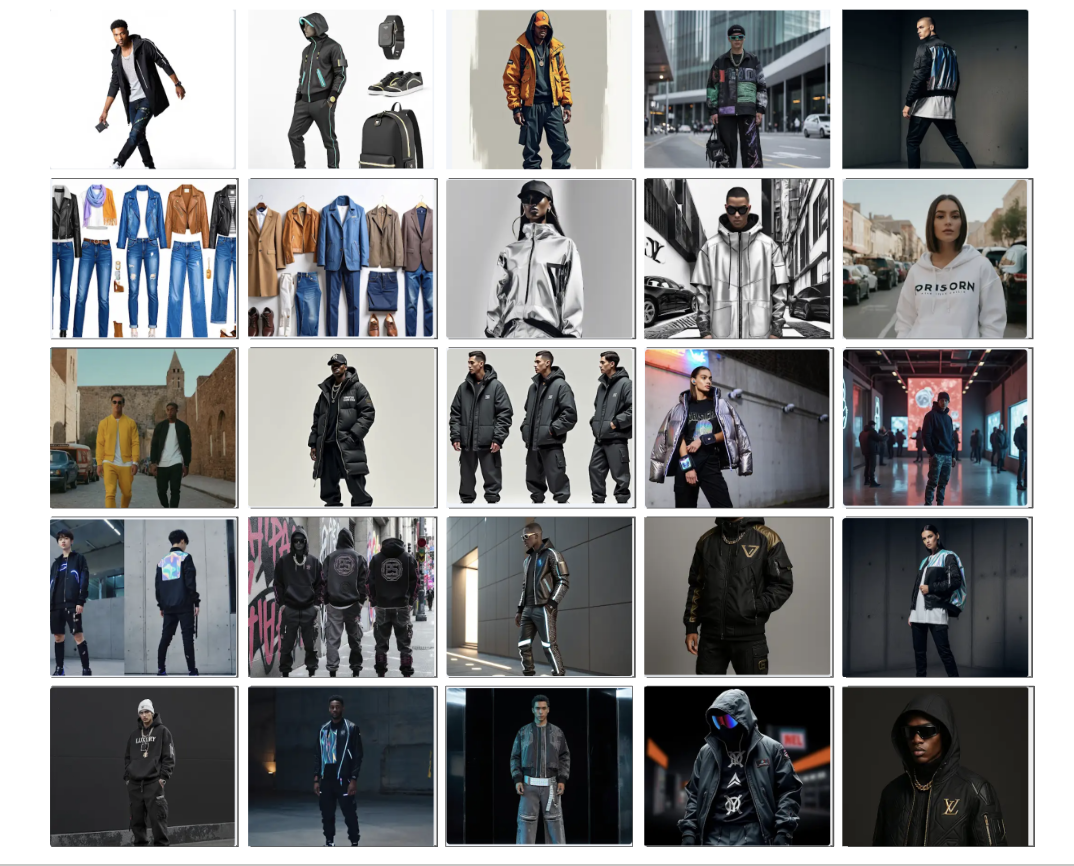
Generative AI urban outfits test image results
What we observed in test A: We analyzed the outputs* from each model to understand which images were most ‘typical’ of the dataset and which stood out as outliers. The results were surprisingly uniform. Across the 13 different models, most generated very similar images particularly in pose, styling, and layout. Adobe Firefly was the only model that opted not to present clothing on a human figure. Of the 25 images, just 4 of them were female-presenting figures. In just 4 images out of 25 were female-presenting figures.
When looking at how the generative AI models interpreted streetwear, the aesthetic was not only generic but also all stuck to a very similar pattern.
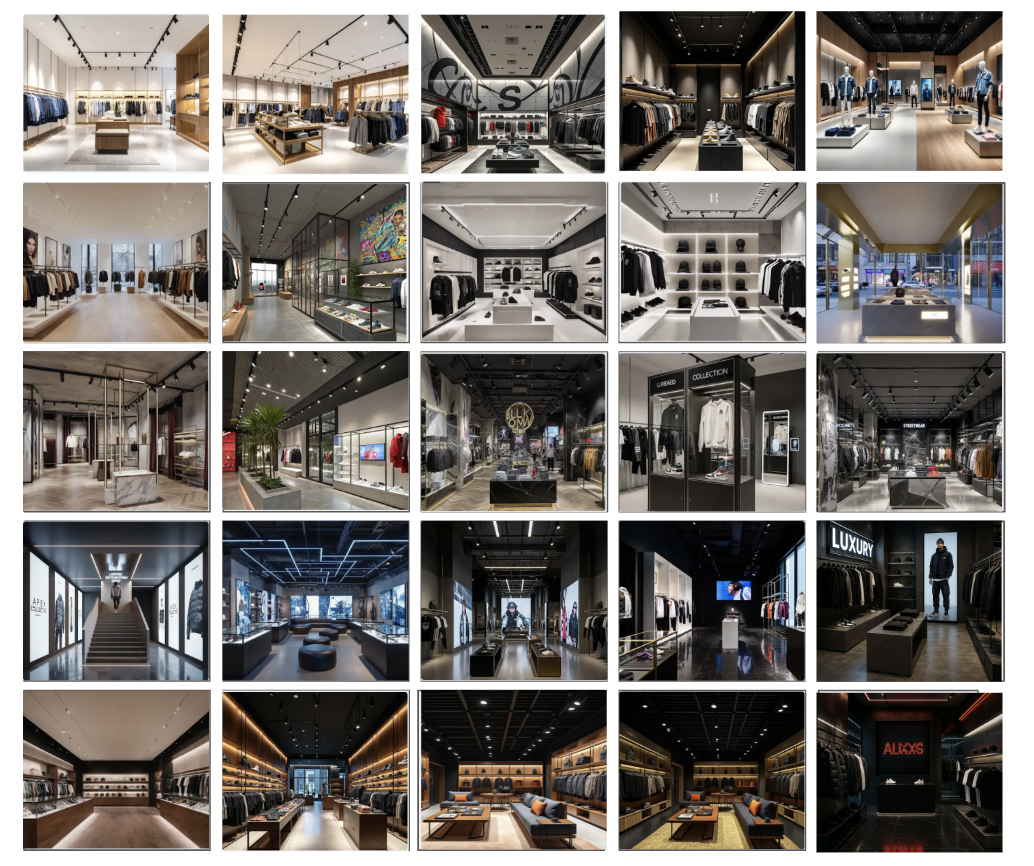
Generative AI retail space test image results
What we observed in test B: While there were some differences in execution, the outputs were more similar than they were different. Almost all models defaulted to minimalist, monochrome or neutral-toned layouts, shown from a similar eye-level perspective, within similarly sized retail spaces. The minor differences such as different lighting hue or display shape tended to blend in rather than stand out.

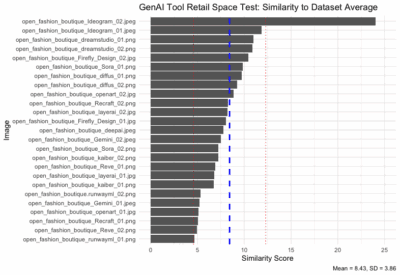
This points to a broader challenge; if Gen AI is increasingly used to generate brand assets and environments, we risk moving toward visual homogenization. Over time, this could desensitize audiences and reduce the distinctiveness of brand assets.
In both tests, with the freedom in the prompt for creativity, the models leaned on shared visual defaults: similar silhouettes, similar backdrops, and similar interpretations of what “streetwear” or “luxury” looks like.
This highlights a huge red flag for brands that are thinking of ramping up Gen AI content for their business; Brand distinction is central to growth; it’s Byron Sharp 101.
Brand distinction depends on more than just execution. It relies on a deep understanding of cultural signals, originality, and consistent unique visual identity. What this exploration has shown is that without detailed specificity in the prompts, Gen AI models will default to the average.
Our key takeaways:
- Gen AI struggles with cultural nuance, leaning too often into homogeneity. The
Gen AI models we looked at tend to rely on the most common visual and cultural tropes (potentially there is just more volume of this input training the models). This means outputs often reflect broad, Western-centric or stereotypical interpretations rather than nuanced or locally relevant ones. For industries like fashion or retail where cultural signals and subtext matter, this is a serious limitation. - Open prompts yield generic content, and generic doesn’t cut it. Gen AI is being marketed as a silver bullet for fast, iterative content production. But our testing shows that without detailed, deliberate prompts, the outputs tend to be generic and visually homogeneous. This is especially risky when brands integrate these tools to their existing processes at scale. It will lead to content that looks and feels the same, regardless of brand, channel, or audience. Blandness dilutes branding.
- Brand distinctiveness is at risk without a strategy for AI integration. If brands adopt Gen AI content without a strong creative strategy – including foundational work such as prompt testing, refinement, and alignment with brand identity – they risk eroding their distinctiveness. In a landscape where everyone is using the same tools and chasing the same efficiencies, standing out will depend on how brands use AI, not just that they use it.
Looking ahead, it will be fascinating to see how Gen AI evolves to deliver more culturally nuanced and creatively distinctive outputs. But for now a key question remains: how much specificity must be built into prompts to avoid generic, bias-driven results? And critically how much time and effort will it take to get those prompts right, consistently and at scale?
There is, as yet, no shortcut. For brands and creators aiming to use Gen AI meaningfully, success will require careful tool selection, prompt strategy, and ongoing testing.
It’s not just about producing more content, faster, it’s about ensuring that content reinforces brand identity, rather than diluting it in a sea of sameness.
Speed will always matter, but distinction is what audiences remember. That’s what brands risk losing if they treat Gen AI as a shortcut instead of a tool.
Methodology:
Tools included: Adobe Firefly, Deep AI, Diffus, Dreamstudio, Gemini, Ideogram, Kaiber, Layer AI, Openart AI, Recraft, Reve, Runway ML & Sora
Total of 25 images created, all provided x2 apart from DeepAI
Prompt A used: Design a luxury streetwear outfit that embodies a bold, high-end identity, seamlessly blending contemporary fashion, cutting-edge technology, and urban culture. The outfit should feel modern and exclusive, with clear connections to street aesthetics, yet remain open-ended enough to allow creative interpretations of style, materials, and technological integration. Emphasise a unique and distinctive vision without overly specific constraints, encouraging innovative approaches and diverse aesthetic expressions.
Prompt B used: Design the interior of a high-end retail store for a luxury streetwear brand. The store should feel exclusive, modern, and innovative, with a strong connection to contemporary street culture. Create a layout that reflects a bold identity and its focus on high-end fashion. Feel free to explore different materials, design styles, and technological elements to enhance the store’s atmosphere.
Analysis using R & EBImage package. This package provides simple feature extraction and a quantitative distance analysis of each image to the ‘typical’ average in the dataset based on bright/dark, cluttered/clean, tone, structure, etc. It does not understand semantic content, or group images by style or function.